EV Workshop Readiness Checklists
Explore equipment for two workshop roles: EV and hybrid general service, and high voltage battery repair specialists.
0 of 23 items checked
Your ticks are saved in this browser.EV and Hybrid General Service Workshop Readiness Checklist
For workshops completing general service work on hybrid and electric vehicles, including depowering and reinitialisation, through to high voltage battery removal and replacement.
Personal protective equipment
Category 2 Rated Arc Shield
- Wear when breaking high voltage contacts, such as a high voltage service plug or cable connection (AS 5732:2022).
Category 2 Rated Arc Flash Jacket
The clothing a technician wears to work may not provide adequate protection against the energy release of an electrical arc.
By adding an ArcSafe® T9 Arc Flash Jacket to your workshop’s PPE equipment, you can provide technicians with a practical protective garment to wear when performing tasks such as:
- High voltage depower and reinitialisation procedures, including connecting or disconnecting high voltage components where an arc flash hazard has been identified.
- Other high voltage tasks requiring arc rated protective clothing.
Recommended product
ArcSafe® T9 Arc Flash Switching Jacket →

Category 2 Arc Rated and Class 0 Insulating Gloves
An arc shield and arc rated clothing help protect the face and body. But what about your hands?
TOUCH-e with eVehicleSafe combines 12 cal/cm² arc protection with Class 0 electrical insulation, bringing protection against both arc thermal effects and electrical shock together in one practical automotive glove.
- Must be worn when conducting depower / reinitialisation procedures on high voltage circuits (AS 5732:2022).
Recommended product
Explore TOUCH-e gloves with eVehicleSafe →

Workshop controls and signage
High Voltage Service - Magnetic Wall Mount Caution Sign
- Must be used to define the EV/HEV work area (AS 5732:2022).
- Mount adjacent to the vehicle being worked on, such as on a wall, toolbox or hoist column.
Recommended product
eVehicleSafe High Voltage Caution Sign →
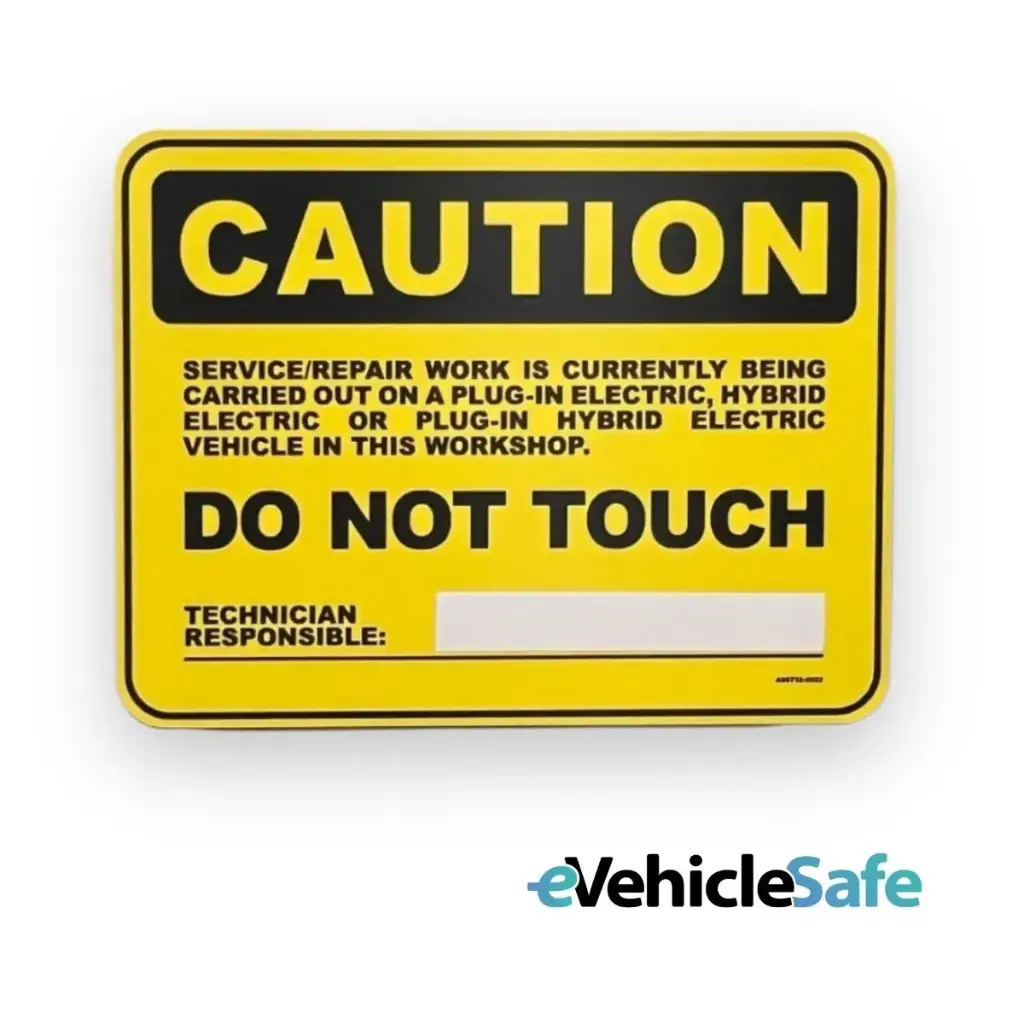
High Voltage Service - Steering Wheel Cover Caution Sign
- Placed over the steering wheel once the vehicle has been depowered to identify high voltage isolation (AS 5732:2022).
- Informs other workshop technicians that the vehicle is in an isolated state.
High Voltage Service - Vehicle Rooftop Caution Sign
- Informs other technicians that a BEV / HEV is undergoing repair within the workshop (AS 5732:2022).
Safety Cones and Barriers
- Used to define the hybrid or electric vehicle work area.
- The need for additional barriers depends on the work being undertaken and the applicable OEM recommendation for that work (AS 5732:2022).
- Barriers are placed around a removed high voltage battery to alert other technicians to the battery’s presence and discourage unintended access or interaction.
Key / Service Plug - Lock Box (LOTO)
- A key or service plug storage box is a useful workplace practice, providing a known location for the vehicle key / service plug removed during a depower / reinitialisation event.
Covered Tools
Covered Hand Tool Kit – Rated to 1,000 V
- Recommended for any work within a battery enclosure / cover.
- Includes screwdrivers, metric sockets and a torque wrench.
Test equipment
Digital Multimeter (DVOM) – CAT III 1,000 V / CAT IV 600 V
- Supports residual voltage checks on high voltage circuits to confirm high voltage isolation, and circuit diagnosis.
- Test leads, probes and accessories must be rated to match CAT III 1,000 V / CAT IV 600 V.
Temperature Compensated (Kelvin) Milliohm Meter
- For equipotential bonding connection checks when removing / replacing high voltage components.
- For checking phase winding resistance within high voltage stator assemblies, such as AC compressors and traction motors, as part of fault diagnosis.
EV Insulation Resistance Tester (Megohm Meter) – CAT III 1,000 V / CAT IV 600 V
- What it does: Applies a controlled DC test voltage to measure insulation resistance between specified HV circuits/components and the chassis, or other test points identified by the OEM.
- Why you need it: Helps diagnose loss of isolation faults and insulation deterioration. Use only the test voltage and component disconnection procedure specified by the vehicle manufacturer, with the circuit de-energised. A tester’s maximum output voltage is not a recommended EV test setting.
Low Voltage Back-probing Kit
- Provides suitable adapters and probes for accessing connector test points during electrical diagnosis.
First aid and safety
First Aid Kit – Burn Module
Recommended product
SURVIVAL Burn Module – Large →
AED On Site Sign
Fully Automatic Defibrillator (AED)
Documents and service information
AS 5732:2022 – Copy of the Standard
Training
AURETH101 – Depower and Reinitialise Battery Electric Vehicles
Appropriate for personnel undertaking the safe depowering and reinitialisation of battery electric vehicles within the scope of this unit of competency.
AURSS00064 – Battery Electric Vehicle Inspection and Servicing Skill Set
Includes AURETH101 and provides broader nationally recognised competencies for the inspection, servicing and diagnosis of battery electric vehicles.
Value adding equipment
AC Service Equipment
Many EVs and hybrids use air conditioning compressors powered by the high-voltage circuit. In vehicles where the AC system also supports battery thermal management, its role extends beyond passenger comfort. AC faults can affect battery temperature control and vehicle operation, making prompt diagnosis and repair in line with the vehicle manufacturer’s procedures important.
High Voltage Battery Repair Specialist
For workshops undertaking repair work within high voltage battery packs.
A high voltage battery repair specialist would typically incorporate all the items listed in the EV and Hybrid General Service Workshop Readiness Checklist above. The sections below cover additional equipment for this specialist work.
Review the general service workshop checklist ↑Additional insulated tools
The general workshop insulated tool kit remains part of this setup. Additional tools for battery repair will be listed here as we build out this section.
Additional test equipment
In addition to the test equipment in the general service workshop checklist:
Battery State of Charge Equipment
Battery Balancing Equipment
Need help equipping your workshop?
Talk to eVehicleSafe about tooling, equipment and training for the work your team plans to undertake.
Contact eVehicleSafe