A practical guide to using the eVehicleSafe Pre-Inspection Kit before bringing hybrid and electric vehicles into the workshop. This page covers equipment operation, intake checks, thermal imaging and carbon monoxide monitoring.
Register Your eVehicle Pre-Inspection Equipment
- Position the unit such that the eVehicleSafe serial numbers can be seen on the equipment.
- Place the specifications sheet and capture a photo with all elements.
- Register each unit using the eVehicleSafe serial numbers.
If you need any assistance completing this procedure, please contact Clinton McLean at +61407551601
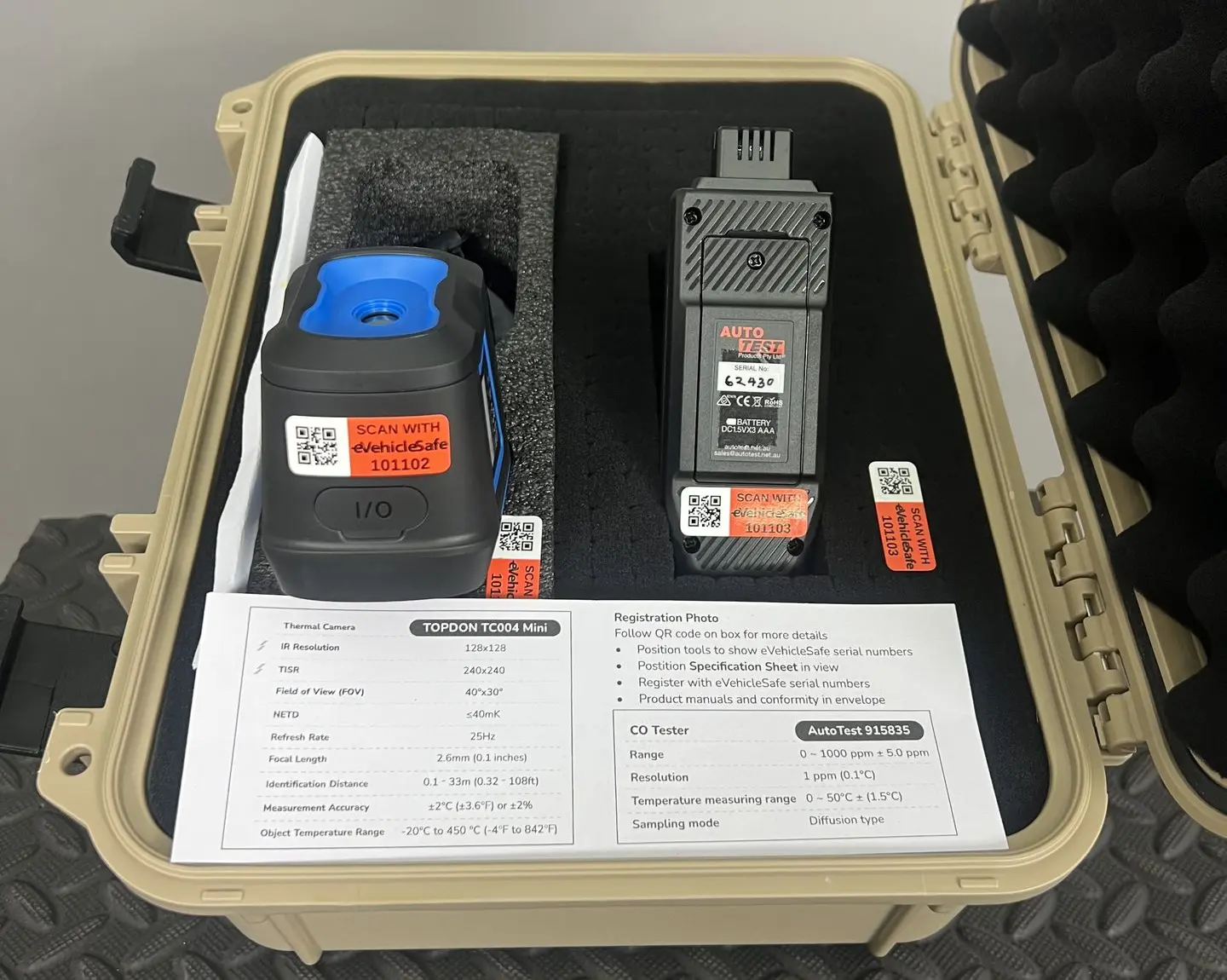
TC004 Mini: Operational Guidance for EV Battery Inspections
The TC004 Mini thermal camera has been pre-configured prior to dispatch and is ready for use.
The camera requires a long press of approximately six seconds to power on. A similar long press is required to perform a complete shutdown.
A short press of the power button does not switch the camera off. Instead, it places the unit into standby mode, allowing the camera to resume operation quickly when required.
The key temperature used is the centre point reading; the camera also displays the maximum and minimum temperatures detected within the image. Pull the camera trigger to save the image.

During operation, technicians will notice the camera periodically pauses while producing a brief clicking sound. This is a normal function of the automatic infrared shutter calibration. The shutter refreshes the sensor at regular intervals to maintain image quality and temperature measurement accuracy.
The most accurate results are achieved by maintaining a clear line of sight to the inspection surface and keeping the component within 30cm to the camera.
Understanding Live Readings on the CO Tester

It is important to understand the difference between live measurements and stored readings to ensure inspection results are based on current environmental conditions.
The tool features a MIN/MAX function. When activated, the instrument no longer displays the current carbon monoxide concentration. Instead, it will display the last minimum or maximum value recorded since the function was enabled. The value could likely be 0ppm.
If the technician is unaware that MIN or MAX mode is active, the displayed value can easily be mistaken for a live reading, potentially leading to an incorrect assessment of the work environment. Returning the instrument to live measurement mode requires pressing and holding the MIN/MAX button.
The HOLD function presents a similar result. Designed to freeze the display for recording results, HOLD prevents the instrument from updating the displayed concentration until the function is cancelled.
Before commencing any inspection, technicians should verify that neither MIN, MAX, nor HOLD indicators are displayed, confirming that the instrument is reporting real-time carbon monoxide levels.
The tester is configured to automatically switch off after approximately 15 minutes of inactivity. For technicians performing extended monitoring or training exercises, the APO function can be disabled by pressing and holding the APO button for more than one second. It can be re-enabled using the same procedure.
eVehicleSafe Pre-Inspection Procedure
Assessment Area Requirements
Before commencing the inspection, ensure the vehicle is positioned in a safe area that can be isolated if required – this should be outside of the workshop.
The vehicle must not be positioned inside the workshop during the pre-inspection assessment.
The assessment area should provide sufficient space for the technician to safely move around the vehicle and inspect underneath the vehicle where required. The area should not place the technician at risk from surrounding traffic, vehicle movements, or other workshop activities.
The vehicle should remain stationary and powered down (not in ready state) for at least 30 minutes prior to assessment. This allows battery and component temperatures to stabilise and improves the accuracy of thermal imaging results.
Required Information
Before commencing the assessment, the technician must have access to:
• OEM service information for the vehicle being inspected or the ANCAP Rescue App or the manufacturer's Emergency Response Guide.
• The Licensed Vehicle Tester EV Checklist
Required Equipment:
• Thermal imaging camera meeting Transport Victoria requirements.
• Carbon monoxide meter capable of measuring in parts per million.
• Equipment capable of measuring ambient air temperature.
• Camera-enabled device for recording inspection evidence.
Recommended equipment includes:
• Inspection mat or creeper for under-vehicle inspection.
Personal Protective Equipment
At this stage of the inspection, high-voltage PPE is not required.
The pre-inspection assessment is a visual inspection only. The technician must not touch, disconnect, remove, open, test, or interfere with any high-voltage component.
Standard workshop PPE must be worn in accordance with workplace safety requirements.
Intake Assessment
Before commencing any physical inspection of the vehicle, we must first complete the intake assessment.
The purpose of the intake assessment is to identify any immediate concerns that may indicate the vehicle is unsafe to inspect or may require further investigation before proceeding.
Open the EV Checklist and record the vehicle details, including the Roadworthy Certificate number and the Vehicle Identification Number.
How the Vehicle Arrived at the Premises
If the vehicle was towed to the workshop, confirm that it was transported in accordance with the manufacturer's Emergency Response Guide.
Access the ANCAP Rescue App or the manufacturer's emergency response documentation and confirm the correct towing method for that vehicle was performed.
OEM Electric Vehicle or Conversion
If the vehicle has been modified to include an electric drivetrain, evidence of VASS approval or appropriate engineering approval must be sighted before proceeding.
Is There Any Impact Damage to the High-Voltage Components?
Access the OEM service information and identify the location of the battery, auxiliary batteries, drive motors, charging components and high-voltage orange cabling.
Visually inspect the vehicle for any signs of damage that may affect those systems.
If evidence exists, the roadworthy inspection must cease, and the vehicle must be returned to the owner in accordance with the EV Checklist requirements.
If all intake assessment questions are satisfactory, proceed to the thermal imaging assessment.
Thermal Imaging Assessment
The thermal imaging assessment is used to identify abnormal battery temperatures that may indicate thermal instability or the early stages of thermal runaway.
Confirm the vehicle has been powered down (not in a ready state) for a minimum of 30 minutes.
Using the eVehicle Pre-Inspection Kit
The carbon monoxide tester is used to establish the ambient air temperature for this procedure. Leave the meter positioned inside the box in its foam insert and allow the temperature reading to stabilise.
Note this reading.
Using the thermal imaging camera, inspect the battery as identified from the service information.
In many battery electric vehicles, this will require inspection underneath the vehicle. A creeper or inspection mat may be used; however, there is no requirement to slide under the vehicle.
Move the thermal imaging camera slowly across the battery area and observe any temperature variations.
Position the thermal imager so it can see the entire battery, and capture an image of the area. This will save the image to the device.
Compare the centre point temperature against the ambient reading.
Battery Temperature Not More Than 10 Degrees Above Ambient
Recall the image on the display, place the thermal imager back into the case, and take a photo of both the thermal imager and ambient air temperature to document the result.
Update the EV Checklist and move on to the off-gassing assessment.
Battery Temperature Greater Than 10 Degrees Above Ambient
..Or an area within the traction battery is displaying a temperature greater than 10 degrees above ambient, wait 15 minutes and repeat the assessment of the same area.
If the temperature has increased or remains 10 degrees above ambient during the second assessment, there is a risk the battery may be entering early thermal runaway and the inspection must stop.
The vehicle must be isolated immediately, emergency services must be contacted, and the premises evacuated in accordance with workplace emergency procedures.
Off-Gassing Assessment
The purpose of the off-gassing assessment is to identify potential battery venting, or gas release from a damaged or compromised traction battery.
Remove the carbon monoxide meter from its foam insert, and position it so the sensor is exposed.
Place the eVehicle pre-inspection kit within one metre of the vehicle, on either the driver’s or passenger side door.
If the traction battery is located within the interior of the vehicle.
Place the eVehicle pre-inspection kit in the boot of the vehicle, leaving the lid or hatch open.
Measure
The meter should remain stationary in the inspection kit for a 5-minute monitoring period.
Take a photograph showing the carbon monoxide meter position and its display reading.
If the Reading Is 35 ppm or Higher
Allow the meter to monitor for 15 minutes.
During this time, also observe the vehicle for any visible signs of battery distress.
This includes smoke, vapour, hissing noises, or whistling noise.
If the carbon monoxide reading maintains 35ppm and/or continues to increase, there is a risk the traction battery is off-gassing.
The vehicle must be isolated immediately, emergency services must be contacted, and the premises evacuated in accordance with workplace emergency procedures.
If no abnormal readings or warning signs are present, take a photograph showing the carbon monoxide meter position and its display reading.
The pre-inspection assessment has been completed successfully.
The vehicle may now be moved into the workshop for the roadworthy inspection phase.
Equipment and Training Support
Explore the eVehicleSafe Pre-Inspection Kit, enquire about automotive technical training, or contact eVehicleSafe for help with your equipment and workshop requirements.